Tectonics (from Latin tectonicus; from Ancient Greek τεκτονικός (tektonikós) 'pertaining to building') are the processes that control the structure and properties of the Earth's crust and its evolution through time. These include the processes of mountain building, the growth and behavior of the strong, old cores of continents known as cratons, and the ways in which the relatively rigid plates that constitute the Earth's outer shell interact with each other. Tectonics also provide a framework for understanding the earthquake and volcanic belts that directly affect much of the global population.
Friday, October 9, 2020
Extensional tectonics
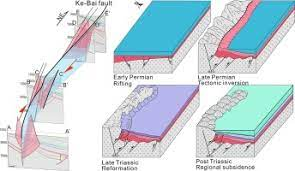
Extensional tectonics is concerned with the structures formed by, and the tectonic processes associated with, the stretching of a planetary body's crust or lithosphere.
Thrust tectonics
Thrust tectonics or contractional tectonics is concerned with the structures formed by, and the tectonic processes associated with, the shortening and thickening of the crust or lithosphere. It is one of the three main types of tectonic regime, the others being extensional tectonics and strike-slip tectonics. These match the three types of plate boundary, convergent (thrust), divergent (extensional) and transform (strike-slip).
Tuesday, October 6, 2020
Strike-slip tectonics
Plate tectonics
Plate tectonics (from the Late Latin: tectonicus, from the Ancient Greek: τεκτονικός, lit. 'pertaining to building') is the generally accepted scientific theory that considers the Earth's lithosphere to comprise a number of large tectonic plates which have been slowly moving since about 3.4 billion years ago. The model builds on the concept of continental drift, an idea developed during the first decades of the 20th century. Plate tectonics came to be generally accepted by geoscientists after seafloor spreading was validated in the mid to late 1960s.
Salt tectonics
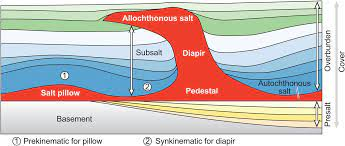
Salt tectonics, or halokinesis, or halotectonics, is concerned with the geometries and processes associated with the presence of significant thicknesses of evaporites containing rock salt within a stratigraphic sequence of rocks. This is due both to the low density of salt, which does not increase with burial, and its low strength. Salt structures (excluding undeformed layers of salt) have been found in more than 120 sedimentary basins around the world.
Neotectonics

Neotectonics, a subdiscipline of tectonics, is the study of the motions and deformations of Earth's crust (geological and geomorphological processes) that are current or recent in geologic time. The term may also refer to the motions/deformations in question themselves. Geologists refer to the corresponding time-frame as the neotectonic period, and to the preceding time as the palaeotectonic period.
Monday, October 5, 2020
Tectonic Landforms
There are a number of different ways to classify landforms. One way is to categorize landforms by how they are created: landforms that are built (depositional), landforms that are carved (erosional), and landforms that are made by movements of the Earth's crust (tectonic). This article is an overview of the most common tectonic landforms.
Coastal landforms
Erosional landforms include headlands, bays, caves, arches, stacks, stumps and wave-cut platforms. There are also depositional landforms such as beaches, spits and bars. The process of erosion can create different landforms along the coastline.
Erosional landforms
There are two major types of coastal morphology: one is dominated by erosion and the other by deposition. They exhibit distinctly different landforms, though each type may contain some features of the other. In general, erosional coasts are those with little or no sediment, whereas depositional coasts are characterized by abundant sediment accumulation over the long term. Both temporal and geographic variations may occur in each of these coastal types.