Showing posts with label LAVA. Show all posts

Sunday, May 9, 2021

Lava


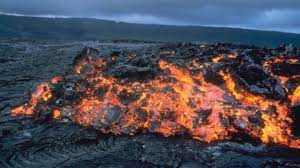
Lava is molten or partially molten rock (magma) that has been expelled from the interior of a terrestrial planet (such as Earth) or a moon onto its surface. Lava may be erupted at a volcano or through a fracture in the crust, on land or underwater, usually at temperatures from 800 to 1,200 °C (1,470 to 2,190 °F). The volcanic rock resulting from subsequent cooling is also often called lava.

Lava morphology

Lava flow is a surficial outpouring of molten rocks. The same name is also given to already solidified rock bodies that formed as molten or semi-molten flows of rocky material. Lava flows are the most common volcanic feature on Earth. They cover roughly 70% of the Earth and are also very common on other terrestrial planets, covering 90% of Venus and 50% of Mars.

Pahoehoe lava


Pahoehoe is a smooth and continuous lava crust. Pahoehoe forms when the effusion rate is low and consequently the velocity of lava flow is slow2. Pahoehoe lava flow is usually at least 10 times slower than typical aa lava flow5. Higher effusion rate results in lava flow being shattered which is how the rubbly and clinkery aa lava surface forms. 

Aa lava


Aa lava is a rough rubbly crust of a lava flow. It is a major lava flow type. Other important subaerial lava flow types are pahoehoe and blocky lava.

Blocky lava


Blocky flows are common if the silica content of lavas is higher (composition of basaltic andesite to rhyolite). Blocky lava flows resemble aa lavas. They also have highly irregular surfaces covered with debris, but they contain larger lava blocks with smoother sides and angular edges with common dimensions from few decimeters to several meters. Blocky flows grow higher as they advance and may reach more than 100 meters in height.

Pillow lava


Pillow lavas are lavas that contain characteristic pillow-shaped structures that are attributed to the extrusion of the lava underwater, or subaqueous extrusion. Pillow lavas in volcanic rock are characterized by thick sequences of discontinuous pillow-shaped masses, commonly up to one meter in diameter. They form the upper part of Layer 2 of normal oceanic crust.

Saturday, May 8, 2021

Lava landforms

Volcanic eruptions have the ability to create many different types of landforms and come in many shapes and sizes.  Landforms that form from lava and ash include shield volcanoes, cinder cone volcanoes, composite volcanoes, lava plateaus, and calderas.  A shield volcano occurs when lava flows out and gradually builds a wide, sloping mountain.  It has a wide base and a flat top.  Shield volcanoes are very large, and their eruptions are nonexplosive.  A cinder cone volcano is the smallest and most common volcano found.  

Lava tube


A lava tube, or pyroduct, is a natural conduit formed by flowing lava from a volcanic vent that moves beneath the hardened surface of a lava flow. If lava in the tube empties, it will leave a cave.

Lava lake


Lava lakes are large volumes of molten lava, usually basaltic, contained in a volcanic vent, crater, or broad depression. The term is used to describe both lava lakes that are wholly or partly molten and those that are solidified (sometimes referred to as frozen lava lakes). Not to be confused with crater lakes, lakes of water that form in a volcanic crater or caldera.

Lava delta

Lava deltas, similar to river deltas, form wherever sufficient sub-aerial flows of lava enter standing bodies of water. The lava cools and breaks up as it encounters the water, with the resulting fragments filling in the adjacent seabed topography such that the flow can move further offshore sub-aerially. Lava deltas are generally associated with large-scale, effusive type basaltic volcanism.

Lava Dome


The structures and textures preserved in lava domes reflect underlying magmatic and eruptive processes, and may provide evidence of how eruptions initiate and evolve. This study explores the remarkable cycles in lava extrusion style produced between 1922 and 2012 at the Santiaguito lava dome complex, Guatemala.